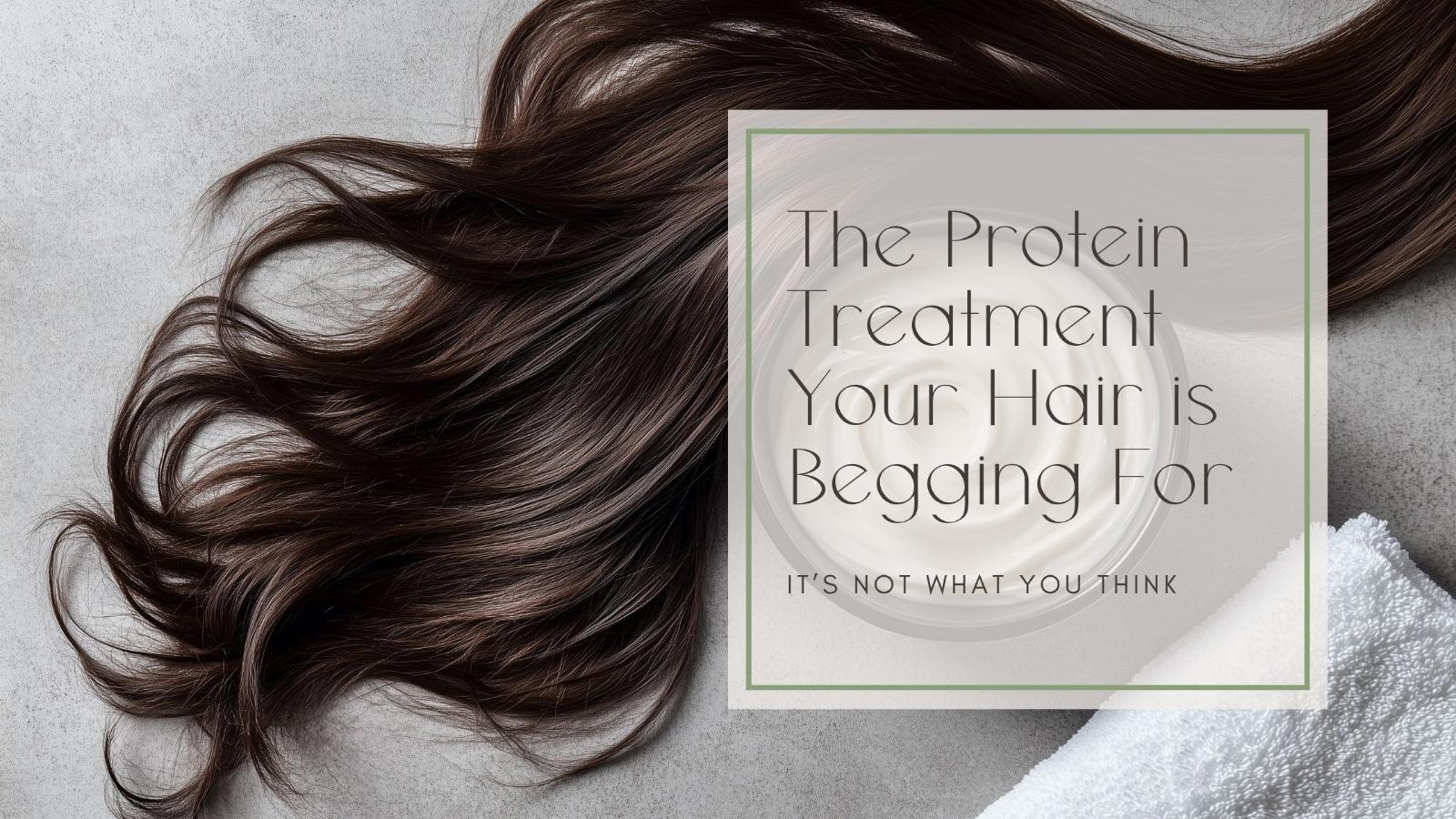
Why Protein Is the Foundation of Healthy Hair (And What Happens When You're Not Getting Enough)
Part 1 of the Feed Your Hair Series, where we explore how what you eat shows up in your hair, your scalp, and even how well your extensions wear.
I know you don't want to hear this, but if you've ever noticed your hair feeling thinner, more brittle, or slower to grow, your diet might be a larger part of your story.
Let me preface by saying I'm not a licensed nutritionist, I'm obviously not a medical practitioner. I'm just a hair stylist with the power of Google research and AI explanations. That is to say, you can get this very same information by searching simple phrases like "how does protein impact hair growth or hair loss."
In the mean time, because I'm a hair stylist who specializes in working with women experiencing fine and thinning hair, I've begun paying attention to how my client's dietary changes show up in their hair. The texture changes, the density shifts, hair that used to hold a style begins to feel lifeless. They lose the ability to simply wear a pony tail... It's from this first-hand witness that I decided a series like this needed to exist, not to be the authority voice on the matter, but to show you that first of all, what you eat matters, and second of all, it doesn't take an expert to acquire this information.
We're going to be traveling on our own magic school bus of sorts through the nutritional panel, first through our macro nutrients and then through our micro nutrients, taking a look at how they each impact our hair and scalp health, whether directly or indirectly.
Let's start at the beginning: PROTEIN.
Your Hair is Basically Made of Protein
Hair is about 95% keratin, which is a type of protein. Every single strand growing from your scalp is built from amino acids, which are the building blocks that create protein, or that which protein breaks down into during digestion. Amino acids are the bricks that the wolf couldn't blow down. Without eating enough of them, your body can't build much of anything, let alone strong, healthy hair.
That sounds really dramatic, I know, but the body considers hair a non-essential bio-material. We don't need it to survive, and so your body is really smart about how it uses the protein you feed it. It prioritizes your protein intake. When your intake is low, protein gets directed toward the most critical functions of your body like organ function, immune response, and tissue repair. Low protein intake could mean that there aren't enough amino acids to send to your hair. Hair growth is one of the first things that slows down (or worse, stops) when resources are limited.
What you need to know is that protein deficiency doesn't show up immediately. Hair only grows about half an inch per month, so what you start to notice in your hair today could be the result of what you were (or weren't eating) two to four months ago, which obviously makes it difficult to pinpoint and connect to nutrition in the first place... oh and by the way, primary practitioners have minimal nutritional training requirements... like a day's worth of required training throughout their entire program... that's not to say that they don't care, they just might also not really know.
What Protein Deficiency Actually Looks Like in your Hair
It's important to know that these symptoms could absolutely be a result of anything else, like iron deficiency, thyroid disorders, chronic stress... so you know, get your labs checked, but if you're anything like so many women across the world, your labs "came back normal" so let's look at how this same symptoms could look in protein deficiency...
Increased Shedding: one of the most common signs is more hair coming out than usual, in the shower, in your brush, when you run your fingers through your hair... Normal daily shedding looks like 50-100 hairs a day on average, but when protein is low, more follicles shift into what's called the telogen phase, the resting-shedding phase, earlier than they should.
Slower growth: if you feel like your hair is stuck at the same length no matter what, protein intake is worth examining. Just the same as stacking bricks builds a wall, hair growth requires the building blocks of protein.
Changes in texture and strength: hair that breaks easily, feels more porous (as in it air dries extremely fast, is frizzy, and easily tangled), or lacks it's usual elasticity can be a sign that the keratin structure isn't being build and/or maintained the way it should be.
Dullness: healthy hair reflects light well, but when the structural integrity of the strand is compromised, it can look flat and lackluster, even when you feel like you're putting all the right products on it.
For my fine-haired clients specifically: fine hair is already more delicate than coarse hair, so the impact of a protein deficiency tends to be more obvious more quickly. If you have fine hair, this is especially worth paying attention to.
The Extension Connection
This is something I discuss with almost every extension client, and I think it matters more than people realize.
Extensions are attached to your natural hair. The strength and integrity of that natural hair is what holds everything in place, and what determines how long your extensions remain comfortable, how long you can wear your extensions, and how healthy your hair comes out on the other side of wearing them... and let me be one of the first stylists to say the goal should never be to wear extensions permanently for forever.
When your hair is protein-deficient, it's more fragile. That means it's more susceptible to breakage at the attachment point, more likely to tangle, and less able to handle the daily tension that comes with wearing extensions. I've seen clients who take really good care of their extensions but consistently have breakage issues, and often times, nutrition is part of the picture.
Eating enough protein supports the strength of your natural hair from the inside out. No product can full substitute for the fact that a healthy body creates healthy hair.
How Much Protein Do You Actually Need?
A simple Google search will tell you that most adults need somewhere in the range of 0.7 to 1 gram of protein per pound of body weight per day... so if you're 150 pounds, you need approximately 150 grams of protein each day. This number varies of course based on your activity level, age, and overall health. If you're very active, pregnant, or recovering from something, you likely need more than that standard baseline.
You should also know that your body doesn't store excess protein the way it stores fat... unfortunately. I mean, if it stored protein instead of fat we'd all be ripped instead of jiggly... but I digress: you need a steady daily supply of protein to keep up with the demands of a healthy body that can support healthy hair growth. Yesterday's chicken breast does not count for today...
The Best Food Sources for Hair-Healthy Protein
I'm not ever going to push any fancy diet on you. I don't believe in diets. You just need to make sure protein is showing up consistently at every meal, and that's super easy to ensure because protein is in everything... it's the structural building block, remember?
Animal Proteins (complete proteins, containing all essential amino acids): eggs, chicken, turkey, fish, and seafood... low-fat greek yogurt, low-fat cottage cheese, and lean beef. Why low-fat? Because if you get full fat, it counts more as a healthy fat instead of a good source of protein.
Plant proteins (often paired together to get a full amino acid profile): lentils, beans, chickpeas, tofu, tempeh, edamame, quinoa, hemp seeds.
Here's a fun tidbit about eggs: they're one of the most bioavailable sources of protein out there, meaning your body absorbs and uses them really efficiently. They also contain biotin, which we'll be talking about in a future post. They're basically a hair superfood. But, eggs are pretty equally proportionate between fat and protein, so I like to up the protein profile by mixing an egg with liquid egg whites and some low-fat cottage cheese. When I eat a breakfast like this, I'm satisfied til nearly dinner!
A Word About Crash Dieting and Hair Loss
I already told you I don't believe in diets but let's address it less subjectively. Diets come up a lot, especially after holidays or before a big event.
Severe caloric restriction almost always means insufficient protein. When your body doesn't have enough fuel or building material coming in, it goes into conservation mode, and hair growth is one of the first casualties. This is why many people notice significant shedding one to three months after a period of very restrictive eating, even if they've since gone back to eating normally. The shedding you're seeing now is often your body catching up to what happened a few months ago.
This type of hair loss is called telogen effluvium and is usually temporary and reverses once nutrition is back on track, but it's real, happens to all women at some point in their lives (typically after pregnancy), and it's worth remembering. And though it reverses, remember that healthy bodies grow hair at only about half an inch per month, so it's going to take approximately a year, maybe longer, for that hair just to reach shoulder length.
The Bottom Line
What I'm shouting from the mountains is this: the best hair care happens from the inside out. We can do a lot with great products, good technique, and thoughtful extension placements, but the raw material we're working with is built by your body, and your body builds it from what you feed it.
Protein isn't complicated or expensive to get enough of. And being intentional about getting enough of it can solve a lot more problems for you than just support healthy hair.
Next month we'll talk about healthy fats, which play a surprisingly big role in scalp health and moisture retention. I'll have you keeping fat on your plate in know time.
If you're in Cottage Grove MN or surrounding Twin Cities area and you're looking for a stylist that understands your hair and the importance of properly matched hair extensions, book your consultation today.